-
Shop
- Advanced Technologies
- AI Career Advantage Collection
- AI Skills
- AI Skills for Creators & Freelancers
- AI Client Management
- AI Ethics
- AI Mindset
- AI Tools & Prompts
- AI Writing & Content Creation
- Audio, Voice & Music
- Design & Visual Creation
- Email, Messaging & Communication
- Freelancing & Business
- Marketing, Ads & Conversion
- Productivity, Workflow & Automation
- SEO & Search Optimization
- Social Media Content & Growth
- Strategy, Planning & Analytics
- Video Creation & Editing
- Bathroom
- Beauty
- Best-Sellers
- Car Accessories
- Car Buying & Ownership
- Confidence
- Dating & Social Skills
- Digital Resources
- AI & Technology
- Budgeting & Saving
- Cozy Feast Collection
- Electronics & Technology
- Emotional Intelligence
- Entrepreneurship & Business Growth
- Financial Education
- Financial Independence
- Financial Mindset & Psychology
- Goal Setting
- Hobbies
- Kitchen & Recipes
- Leadership
- Mindfulness
- Mindset
- Motivation
- Online Business
- Positive Thinking
- Productivity
- Self Confidence
- Sleep Improvement
- Smart Life with AI
- Stress Management & Relaxation
- Travel Planning
- Yoga & Fitness
- Yoga & Mind-Body Practices
- Education & Learning
- Family & Parenting
- Gadgets
- Health & Beauty
- Health & Wellness
- Home & Garden
- Home Styling & Organization
- Home Supplies
- Kids & Babies
- Legend Footwear Brands Collection
- Online Business for Beginners
- Parenting & Child Development
- Patio, Lawn & Garden
- Personal Growth
- Personal Style & Fashion
- Pet Care
- Pet Lifestyle & Wellness
- Pet Supplies
- Pets
- Smart Amazon Shopping
- Stress Relief & Relaxation
- TikTok Growth & Monetization Mastery
- Travel
- Travel & Adventure
- Wealth
- Wellness
- Popular
- Best deals
The Sequel Effect: Make Part 2 Your Biggest Post
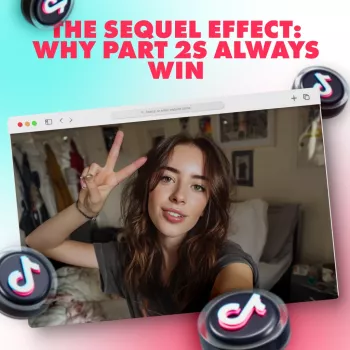
The Sequel Effect: Why Part 2s Always Win (and How to Build a Series That Keeps Getting Shared)
Some posts get polite attention. The next one gets saved, shared, and followed. That’s The Sequel Effect: once someone opts into Part 1, Part 2 feels easier to watch, faster to trust, and more urgent to catch. Our team built this guide for creators and marketers who want repeatable series momentum—so every “next part” lifts reach, retention, and results. For more guidance, see Regulation and Enforcement of Influencer Marketing After Ten ….
Why “Part 2” almost always performs better than “Part 1”
Part 2 usually wins because the viewer is no longer deciding whether you’re worth their time. They’ve already started. That changes everything—attention, trust, and how quickly you can get to the point. For further reading, see The Power of Influencer Marketing in the Digital Age.
- Commitment is already made: viewers who watched Part 1 have less friction to continue (commitment and consistency shows up fast once someone publicly engages).
- Curiosity stays open: a cliffhanger, unfinished promise, or missing step creates a mental loop people want closed (similar to the Zeigarnik effect).
- Context is preloaded: Part 2 can move faster, feel more advanced, and deliver payoff sooner.
- Social proof compounds: Part 2 benefits from Part 1’s comments, saves, and shares—plus viewers tag friends to “catch up.”
- The algorithm gets clearer signals: series content concentrates returning viewers and completion rates.
Part 1 vs Part 2: what changes and what to do about it
| What shifts | Why it helps Part 2 | How to design for it |
|---|---|---|
| Viewer intent | They’re already interested | Open Part 2 with payoff first, then add nuance |
| Attention span | They’ll tolerate less setup | Skip the long intro; start mid-action |
| Trust | Creator credibility is higher | Add a bolder claim, a stronger opinion, or a clearer framework |
| Retention | More people watch to the end | Use quick signposts: Step 1/2/3; mistake #1/#2 |
| Sharing | “You need Part 1” becomes a hook | Pin a comment linking Part 1; keep titles consistent |
If you want a deeper persuasion layer behind why people stick with what they started, Cialdini’s principle of commitment and consistency is the cleanest lens: once someone takes a small action (watching, saving, commenting), continuing feels aligned.
The three ingredients that make a sequel irresistible
Strong sequels aren’t “more tips.” They’re designed to feel inevitable.
- A clear promise: Part 1 must end with a specific outcome Part 2 will deliver (not a vague “more soon”).
- A clean container: viewers should instantly recognize it’s the same series—same format, naming, and structure.
- A payoff ladder: Part 2 should feel like an upgrade (faster win, deeper tactic, stronger example), not leftover footage.
Sequel hooks that pull viewers into Part 2
| Hook type | Example phrasing | Best for |
|---|---|---|
| Payoff reveal | “Here’s the part that actually doubles saves…” | Educational tips and how-tos |
| Correction | “Part 1 worked—unless you’re doing this one thing.” | Marketing, growth, strategy |
| Challenge outcome | “Day 7 results: what surprised me most.” | Experiments, routines, series journeys |
| Behind-the-scenes | “The exact template I used after Part 1 went up.” | Creators, product-based businesses |
| Advanced step | “Now the version for people who already tried it.” | Intermediate audiences |
Build a “Part 1” that’s engineered for a winning “Part 2”
A simple script blueprint for Part 1 and Part 2
| Beat | Part 1 job | Part 2 job |
|---|---|---|
| Opening line | Create the problem + curiosity | Deliver the payoff immediately |
| Core content | Teach the foundation | Teach the shortcut/upgrade |
| Proof | One clear example | A stronger example + results |
| CTA | Invite follow/save and tease Part 2 | Point back to Part 1 and tee up Part 3 |
Turn sequels into a growth system (not a one-off series)
Series formats that naturally create strong Part 2s
| Format | What Part 1 covers | What Part 2 covers |
|---|---|---|
| Mistakes | Top 3 mistakes | Fixes + exact wording/scripts |
| Breakdowns | What happened | Why it worked + how to copy it |
| Frameworks | The model | Examples + customization |
| Before/after | Starting point | Process + results |
| Myths | What people believe | What to do instead + proof |
Use the guide: The Sequel Effect (digital download)
If you want a plug-in structure you can use weekly (instead of reinventing a series every time), our team made The Sequel Effect: Why Part 2s Always Win (digital guide) to help you plan multi-part posts, sharpen sequel hooks, and structure Part 2 for faster payoff and higher retention.
A practical release cadence for sequel momentum
| Day | Post | Goal |
|---|---|---|
| Day 1 | Part 1 | Hook interest + open the loop |
| Day 2–3 | Part 2 | Deliver payoff + boost saves/shares |
| Day 4–7 | Part 3 | Handle objections + convert attention into action |
If you’re building a creator workflow beyond content (confidence, routines, and personal momentum matter), you may also like our in-stock reads: Confident Again: Your Step-by-Step Guide to Rebuilding Self-Belief – eBook and Styling High-End Living Room | eBook Guide.
FAQ
How long should a content series be to get the sequel effect?
Plan for 2–3 parts as your baseline: Part 2 is the key payoff, and Part 3 is where you handle objections or add the advanced step. Consistency in format and naming matters more than stretching the series longer.
What if Part 1 underperforms—should Part 2 still be posted?
Yes—Part 2 can still outperform because it’s clearer and delivers the outcome people wanted. Tighten the first line, add a one-sentence recap, and explicitly point viewers back to Part 1 so they can catch up fast.
What’s the fastest way to make Part 2 get more saves and shares?
Lead with the payoff, use a step-by-step structure, include a template/script people can copy, and end with a direct prompt to save. Keep the naming and visual container consistent so your audience recognizes it instantly.
Recommended for you

October Prime Day Explained: Deals, Timing, Rules
Oct 17, 2026













Leave a comment