How to Choose a Domain Name: Startup Checklist
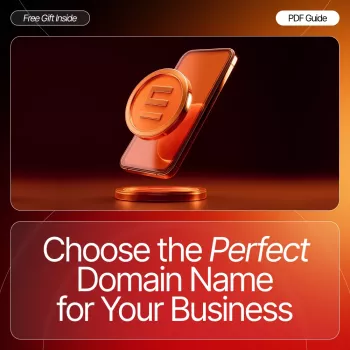
Choose the Perfect Domain Name: A Practical Checklist for Startups and New Businesses
A domain name is the front door to a brand—easy to say, easy to trust, and hard to forget. The right choice supports word-of-mouth, search visibility, email credibility, and future product lines. Our team uses a repeatable process: get clear on what the domain must do, generate options fast, stress-test them for confusion and legal risk, then choose with confidence using a simple scoring method.
Start with clarity: what the domain needs to accomplish
Before you brainstorm names, decide what “good” looks like for your business. This prevents you from falling in love with a domain that’s clever—but wrong for your goals.
- Write a one-sentence brand promise and pull 3–5 core words from it (what you do, who it’s for, the outcome).
- Decide the primary use: brand-only (best for scaling) or descriptive (useful when you’re new and need instant context).
- Set non-negotiables now: max length, language, tone (premium, playful, minimalist), and whether it must match your business name exactly.
- List future directions (new categories, broader audience, additional locations) so you avoid a name that boxes you into one niche.
- Choose the domain’s job in the funnel: discovery (memorable), trust (professional), or conversion (clear relevance).
A fast checklist for generating strong domain candidates
You’ll get better options by producing volume first, then filtering hard. Aim to generate 20–30 candidates quickly, without judging too early.
- Aim for 6–14 characters when possible; shorter usually wins for memorability and typo resistance.
- Prefer one or two words; three-word domains invite errors unless the phrase is extremely common.
- Avoid hyphens and doubled letters (they increase mishearing and mistyping).
- Choose pronunciation-friendly spelling; if you have to explain it every time, it becomes a hidden tax on growth.
- Use “brandable + hint” patterns: a distinctive word paired with a subtle cue like “studio,” “labs,” “co,” or “shop.”
- Keep it clean for email: imagine saying it out loud in customer support and spelling it over the phone.
Domain candidate quick-screen
| Test | What to look for | Red flags |
|---|---|---|
| Say it out loud | Clear pronunciation on first try | People ask for spelling or repeat it incorrectly |
| Spell it from memory | Easy to type after hearing once | Multiple plausible spellings (ph/f, i/y, swapped vowels) |
| Two-second meaning check | Conveys vibe or category without explanation | Feels generic or confusingly broad |
| Mobile typing | No awkward thumb gymnastics | Hyphens, numbers, repeated letters, uncommon characters |
| Brand extension | Works if your product line expands | Locks you to one product, city, or trend |
Choose an extension that fits the brand and the plan
Your extension is part of the brand impression. The “right” choice depends on your audience, your growth plans, and how much confusion you can tolerate.
If you want the registration system and basic rules straight from the source, ICANN maintains a helpful overview of domain registration and management: https://www.icann.org/.
Screen for confusion, legal risk, and brand conflicts
- Run a trademark sanity check before you get attached. In the U.S., you can start with the USPTO’s TESS search: https://tmsearch.uspto.gov/.
- Search the exact phrase and close variants to see who already “owns” the mental real estate in your category.
- Check social handle availability for the same name (or a consistent variation) so your brand doesn’t fragment.
- Look for homophones and near-misses that could leak traffic or cause repeated “No, the other one” conversations.
- Avoid accidental meanings in other languages or slang if your audience is international.
Make the final decision with a simple scoring method
Want a ready-to-use checklist you can share with your team?
We keep the process simple with our Choose the Perfect Domain Name for Your Business Checklist, so you can move from brainstorm to buy with fewer loops and less second-guessing.
Use the checklist to move from ideas to a domain you can own
If decision fatigue is creeping in, it also helps to strengthen how you evaluate tradeoffs under pressure. Our team recommends building that skill intentionally; Confident Again: Your Step-by-Step Guide to Rebuilding Self-Belief is a practical way to steady your decision-making when every choice feels high-stakes.
FAQ
Should a startup choose a brandable domain or a keyword-based domain?
A brandable domain is easier to grow beyond your first offer and tends to be more defensible over time, while a descriptive domain can help new customers understand what you do immediately. If you’re torn, use a brandable name and add clarity through your tagline, homepage headline, and email signature.
What if the .com is taken—what is the next best move?
Your safest path is usually to adjust the name slightly (or add a short modifier) so you can own a domain that’s easy to recall and hard to confuse. If a close competitor owns the .com, be extra cautious with alternate extensions and test real-world recall to avoid misdirected traffic and emails.
How many domain candidates should be shortlisted before deciding?
Generate 20–30 options first so you don’t settle too early, then narrow to 5–7 finalists. Score them, do a quick write-it-down test with a handful of target customers, and choose the one that stays strong after a day away from the list.















Leave a comment