-
Shop
- Advanced Technologies
- AI Career Advantage Collection
- AI Skills
- AI Skills for Creators & Freelancers
- AI Client Management
- AI Ethics
- AI Mindset
- AI Tools & Prompts
- AI Writing & Content Creation
- Audio, Voice & Music
- Design & Visual Creation
- Email, Messaging & Communication
- Freelancing & Business
- Marketing, Ads & Conversion
- Productivity, Workflow & Automation
- SEO & Search Optimization
- Social Media Content & Growth
- Strategy, Planning & Analytics
- Video Creation & Editing
- Bathroom
- Beauty
- Best-Sellers
- Car Accessories
- Car Buying & Ownership
- Confidence
- Dating & Social Skills
- Digital Resources
- AI & Technology
- Budgeting & Saving
- Cozy Feast Collection
- Electronics & Technology
- Emotional Intelligence
- Entrepreneurship & Business Growth
- Financial Education
- Financial Independence
- Financial Mindset & Psychology
- Goal Setting
- Hobbies
- Kitchen & Recipes
- Leadership
- Mindfulness
- Mindset
- Motivation
- Online Business
- Positive Thinking
- Productivity
- Self Confidence
- Sleep Improvement
- Smart Life with AI
- Stress Management & Relaxation
- Travel Planning
- Yoga & Fitness
- Yoga & Mind-Body Practices
- Education & Learning
- Family & Parenting
- Gadgets
- Health & Beauty
- Health & Wellness
- Home & Garden
- Home Styling & Organization
- Home Supplies
- Kids & Babies
- Legend Footwear Brands Collection
- Online Business for Beginners
- Parenting & Child Development
- Patio, Lawn & Garden
- Personal Growth
- Personal Style & Fashion
- Pet Care
- Pet Lifestyle & Wellness
- Pet Supplies
- Pets
- Smart Amazon Shopping
- Stress Relief & Relaxation
- TikTok Growth & Monetization Mastery
- Travel
- Travel & Adventure
- Wealth
- Wellness
- Popular
- Best deals
Smart Study Habits for Teens: Printable Plan + Tools
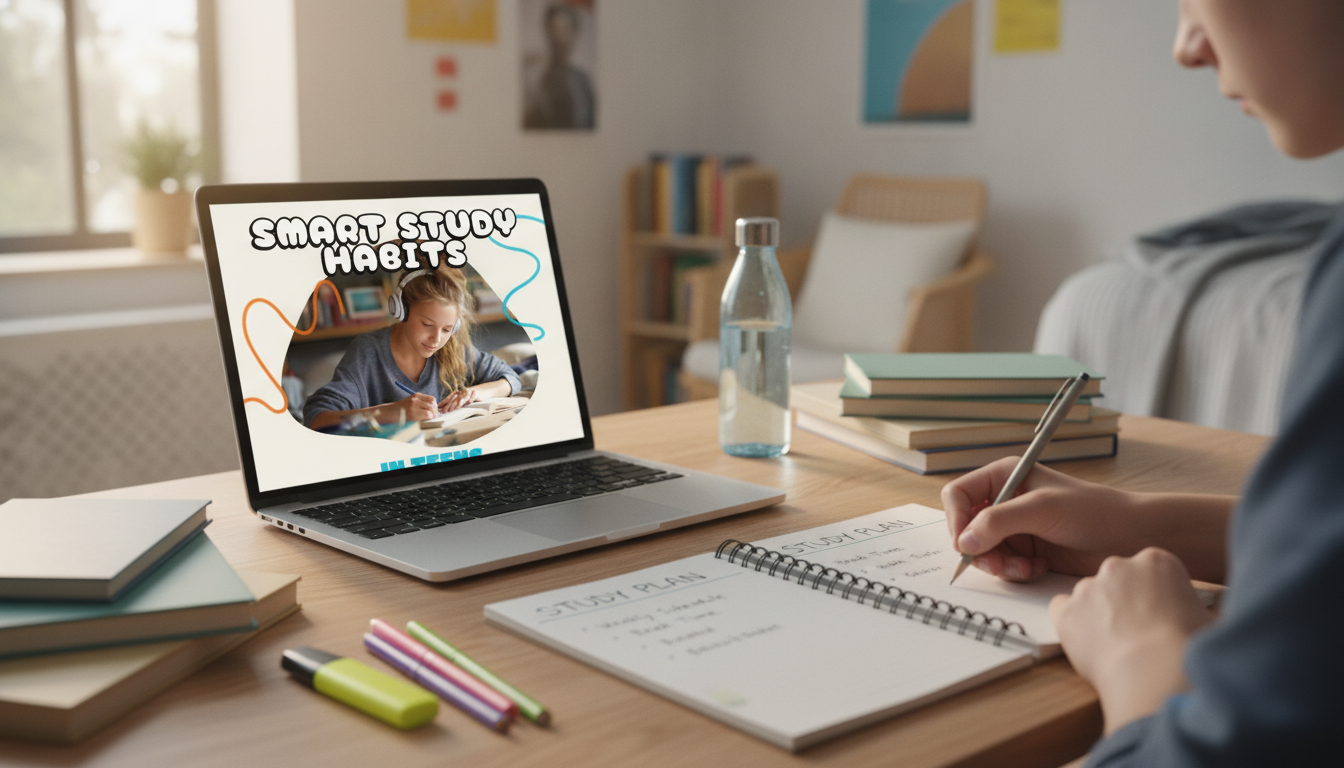
Building Smart Study Habits in Teens: A Practical, Printable Plan for Parents and Educators
Strong study habits are less about “trying harder” and more about building repeatable systems teens can actually follow. With busy schedules, digital distractions, and uneven motivation, the most effective support combines clear routines, manageable expectations, and consistent feedback. Below is a practical framework families and schools can use together—plus printable tools that make the plan easier to start and stick with.
What Gets in the Way of Consistent Studying (and What Helps Instead)
Teen brains are still building the skills that make studying feel “automatic.” Planning, prioritizing, and self-monitoring (often called executive function) can be inconsistent day to day, especially when stress, sleep debt, or social pressure is high. The fix usually isn’t more nagging—it’s more structure.
- Executive function is still developing: Provide scaffolding (simple checklists, short routines, visual plans) until the teen can run the system independently.
- Motivation fluctuates: Lean on routines and environment design instead of waiting to “feel motivated.”
- Overwhelm creates avoidance: Smaller steps and a clear “next action” reduce friction and get momentum going.
- Digital distraction is cue-based: Change cues (phone location, notifications) and add replacement behaviors (timer, paper checklist, music-only playlist if it helps).
- Stress and sleep debt reduce learning: Protect recovery as part of the study plan; sleep is a performance tool, not a reward. For sleep guidance, see the CDC’s sleep resources.
Set a Baseline: Identify the Minimum Effective Study Routine
Consistency beats intensity. Start with the smallest routine that can happen on most school nights, then scale up only after it’s stable.
- Take a weekly snapshot: current grades, upcoming deadlines, and the teen’s after-school schedule (sports, work, clubs).
- Choose a realistic baseline: many teens do well starting with 20–30 minutes of focused work on school nights before expanding.
- Use a “next task” list: one subject + one specific action (example: “math: complete problems 1–10”).
- Agree on “done”: turned in, checked, and logged—not just “worked on it.”
- Plan exceptions: build a catch-up block (example: 30–45 minutes on Sunday) for sports games, shifts, or family events.
A Parent–Educator Partnership That Builds Independence
The goal is independence, not dependence on reminders. Alignment between home and school reduces mixed messages and helps teens practice the same routine across settings.
- Pick one shared goal for 2–3 weeks: on-time submission, nightly review, or a test prep routine.
- Use consistent language: “plan, start, focus, finish, reflect.”
- Keep check-ins short: 5 minutes after school or after dinner, plus a weekly reset.
- Swap reminders for prompts: checklists, planner cues, or calendar alerts the teen manages.
- Give behavior-based feedback: time started, tasks completed, errors corrected—rather than labels like “lazy” or “smart.” For more on adolescent development, the American Psychological Association’s teen resources are a helpful reference point.
Make Studying Easier with the Right Environment
Environment is a “silent partner” in habit-building. If the default setup makes distraction easy, studying will stay hard—even for capable students.
Study Habit Builder: Common Problems and Simple Fixes
| Challenge | What it Looks Like | Small Fix to Try This Week | Printable Tool to Support It |
|---|---|---|---|
| Late starts | Homework begins hours after getting home | Set a 10-minute “start window” after snack; write the first task before opening a laptop | Daily start checklist + timer card |
| Distraction loops | Switching tabs/apps; checking phone repeatedly | Phone parking + 25/5 focus cycle; block one distracting site during focus time | Focus sprint tracker |
| Overwhelm | “I don’t know where to start” | Break work into 3 micro-steps; complete the first in under 5 minutes | Task breakdown worksheet |
| Missing work | Assignments done but not submitted | End-of-session “submit and log” routine; quick portal check | Turn-in checklist |
| Cramming | Studying only the night before tests | Add two 10-minute review sessions earlier in the week | Weekly study map |
Teach High-Impact Study Skills (Without Turning into the Homework Police)
Skillful studying is about using methods that reliably build memory and understanding. Research consistently supports strategies like active recall and spaced practice over rereading and highlighting. A useful overview is Dunlosky et al. (2013) on effective learning techniques (read here).
Accountability That Doesn’t Create Power Struggles
Printable Support: A Ready-to-Use Digital Guide for Home and School
If you want a ready-made set of pages to simplify planning, focus sprints, and turn-in routines, see Building Smart Study Habits in Teens (Printable PDF Download).
Recommended Resources (Digital Downloads)
- Building Smart Study Habits in Teens | Digital Guide for Parents & Educators | Printable PDF Download (structured pages for weekly planning, focus cycles, and follow-through)
- Clear Pathways: Mastering High-Traffic Spaces at Home (a practical organization guide to reduce clutter in busy areas that often become default “drop zones” and derail study setups)
FAQ
How long should a teen study each day?
For many teens, a consistent baseline of 20–60 minutes on school nights works well, adjusted for workload, grade level, and sports or job schedules. Try 25 minutes focused + 5 minutes break for 1–2 cycles, then review weekly and adjust during a short “reset” meeting.
What if a teen refuses to study or argues about homework?
Lower the friction by defining the first task in a micro-step (something that takes under five minutes) and shifting to brief, predictable check-ins rather than repeated reminders. Use earned autonomy and clear boundaries around leisure time, and loop in teachers or a counselor if refusal is persistent across classes or weeks.
Are printable study habit tools better than apps?
Printables often reduce notifications and multitasking because the plan stays visible without a screen, but either approach can work if it’s simple and teen-owned. Choose the option that’s easiest to use daily, consistent across home and school, and supports follow-through (especially “submit and log”).
















Leave a comment